Comparative Effects of Topically Applied Tocotrienol (T3) Isomers in Promoting Cutaneous Wound Healing in Obese Type 2 Diabetes Mice
Tocotrienols in Diabetic Wound Healing
Abstract
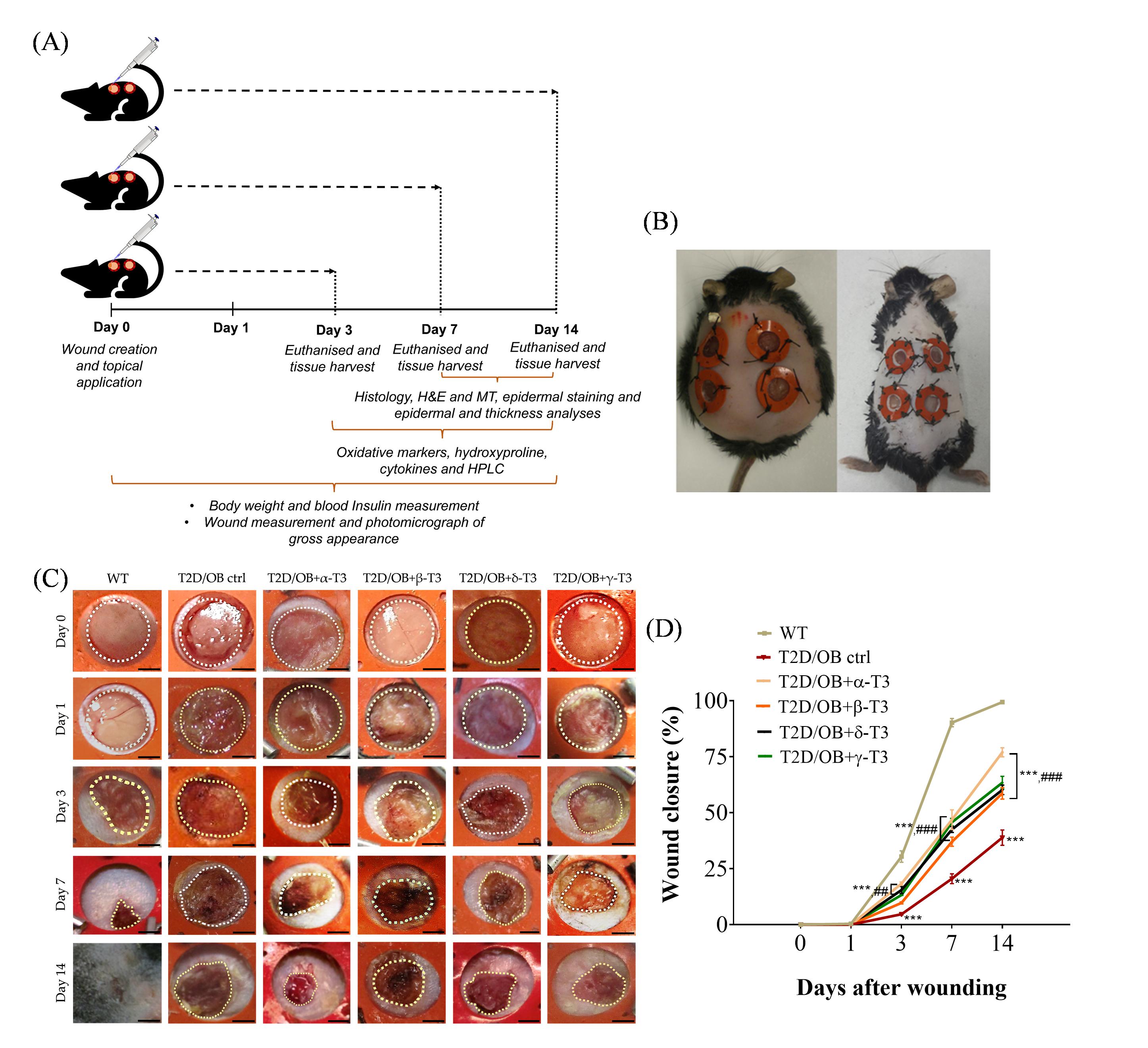
Diabetic foot ulcers are a significant complication, especially for type 2 diabetes and obese patients. This is mainly caused by an excessive and persistent inflammatory-oxidative stress environment in the wounds, which impedes healing. Tocotrienol, a phytochemical with antioxidant and anti-inflammatory properties, holds notable therapeutic potential. Therefore, this study aimed to investigate the healing effects of topically applied tocotrienol isomers (α-, β-, δ- and γ-T3) on full-thickness excisional cutaneous wounds in male B6.V-Lepob/JRj mice. Treatment effects were evaluated through wound closure rate, histopathology, collagen deposition, hydroxyproline content and the levels of superoxide dismutase, catalase, glutathione peroxidase, glutathione, malondialdehyde and myeloperoxidase in the wound granulation tissues. Cytokine, chemokine, and growth factor levels were quantified using the Luminex assay. The presence of isomers in wound granulation tissue was determined by high-performance liquid chromatography. Results showed that T3 isomers facilitated tissue regeneration and hastened wound closure. They significantly reduced oxidative stress by lowering malondialdehyde and myeloperoxidase levels and by enhancing antioxidant activity and production. These isomers effectively diminished pro-inflammatory cytokines and chemokines, while increasing anti-inflammatory cytokines and modulating growth factors, thereby promoting wound healing in B6.V-Lepob/JRj mice. These findings suggest that T3 isomers may serve as therapeutic agents that enhance cutaneous wound healing in individuals with diabetes.
Keywords :
Anti-inflammatory; antioxidant; skin wound healing; tocotrienol; topical treatment; type 2 diabetic mice,
Abstrak
Ulser kaki diabetes merupakan komplikasi signifikan terutama bagi pesakit diabetes jenis 2 dan obes. Ini disebabkan oleh persekitaran keradangan dan tekanan oksidatif yang melampau serta berterusan di dalam luka, justeru menghalang penyembuhan. Tokotrienol, sejenis fitokimia dengan sifat antioksidan dan anti-radangnya, berpotensi sebagai terapeutik yang berkesan. Oleh itu, kajian ini bertujuan menyelidik kesan penyembuhan isomer tokotrienol (α-, β-, δ- dan γ-T3) secara topikal terhadap luka kulit eksisi ketebalan penuh pada mencit jantan B6.V-Lepob/JRj. Keberkesanan rawatan dinilai melalui kadar penutupan luka, histopatologi, pemendapan kolagen, kandungan hidroksiprolin dan tahap superoksida dismutase, katalase, glutation peroksidase, glutation, malondialdehid dan mieloperoksidase dalam tisu granul luka. Tahap sitokin, kemokin dan faktor pertumbuhan diukur menggunakan asai Luminex. Kehadiran isomer dalam tisu granulasi luka ditentukan oleh kromatografi cecair berprestasi tinggi. Keputusan menunjukkan bahawa isomer T3 membantu penjanaan semula tisu dan mempercepatkan penutupan luka. Ia mengurangkan tekanan oksidatif dengan menurunkan tahap malondialdehid dan mieloperoksidase, sambil meningkatkan aktiviti dan pengeluaran antioksidan. Isomer ini berkesan mengurangkan sitokin dan kemokin pro-radang, sambil meningkatkan sitokin anti-radang dan memodulasi faktor pertumbuhan, dengan itu menggalakkan penyembuhan luka dalam mencit B6.V-Lepob/JRj. Penemuan ini menunjukkan bahawa isomer T3 mampu berfungsi sebagai agen bioaktif terapeutik yang mempercepatkan penyembuhan luka kulit bagi individu yang menghidap diabetes.
Kata Kunci :
Anti-radang; antioksidan; mencit diabetik jenis 2; penyembuhan luka kulit; tokotrienol,
rawatan topikal,
Correspondance Address
Correspondence: suzanamakpol@hctm.ukm.edu.my (SM); zaizuhana@mpob.gov.my (ZS)